

The Herzl Room
Essay Film, Germany, 6 minutes, 2022
Synopsis:
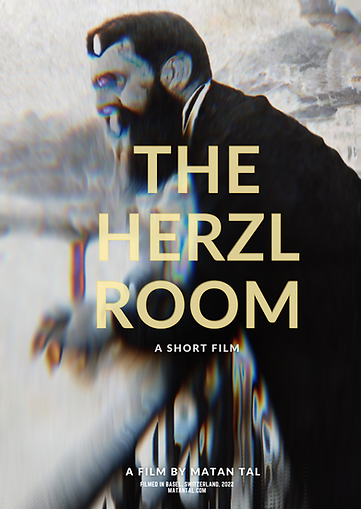
Hotel rooms are rarely the destination for pilgrimage. In one hotel room, an iconic picture was taken - the portrait of Theodor Herzl, the most renowned zionist leader. Filmmaker Matan Tal visits the room and explores how the connection between Herzl and the room, echos Herzl’s own ideology. Which raises the question: Can people and places be connected forever?


.png)
Crew:
Filmmaker: Matan Tal
Status:
Available online for free. For Screening, please contact the filmmaker.
FAQ — The Herzl Room
A film by Matan Tal
1) What is this film about — in one sentence?
As I frame it in the film, The Herzl Room is about one question: can people and places be connected forever? 
2) What genre is this film (and how would you describe its form)?
I would call this film an essay film — but a playful one.
Formally, it borrows from the travel vlog and the travelogue, but deliberately deviates from what those formats usually do. Instead of “showing you the place,” I inhabit it, question it, and examine it philosophically and existentially. It looks like a travel vlog on the surface, but it doesn’t care about being informative. That deviation is exactly what pushes it into the space of an essay film. 
3) Why did you make this film?
I made this film because I always wanted to visit the luxurious hotel room that Theodor Herzl stayed in.
When I was younger — somewhere between junior high and high school — I visited Basel with my mother. I remember standing on a bridge overlooking the hotel balcony, hearing the guide say: “That’s the balcony Herzl stood on in the famous photograph.” I remember telling my mother, very clearly: One day, I’ll stay in that hotel and stand on that balcony.
Years later, I did exactly that. The Herzl Room exists because I kept that promise to myself. 
4) What is the central idea or question the film explores?
The central question emerged naturally once I was in the room.
Herzl is the founder of modern political Zionism. He stayed in this room for only a few days, spread over several visits to Basel. And yet, the room is preserved. His name is embroidered on the walls. People still travel there to stand on the balcony and photograph themselves in his place.
So I became curious: Herzl argued for an eternal connection between a people and a land — and here we have an eternal connection between a man and a hotel room. He is long dead. He is nowhere to be found. And yet, when I entered, it wasn’t the Matan Tal room. It was still the Herzl Room.
That contradiction felt too rich not to examine in a film. 
5) What should the viewer pay attention to while watching?
I think the viewer will inevitably notice me.
My approach to life — and to this film — is that life is ridiculous. It’s a joke. So you see me dancing on Herzl’s bed, smoking a cigar in his bathtub, eating spicy food on his fancy chair.
That’s not provocation for its own sake. That’s my way of testing how much reverence, seriousness, and ideology a place can actually withstand before it collapses into absurdity. 
6) What is your approach to editing in this film?
My approach to editing here was driven by rhythm.
While editing, I was thinking about YouTube travel vloggers — the way they cut visits to places, how they guide you through spaces, how everything is always happening. People like Casey Neistat came to mind.
But instead of reproducing that style, I exaggerated it, twisted it, and pushed it toward satire. The editing mimics the travel-vlog rhythm while exposing how ridiculous that format can be when it pretends to offer meaning. 
7) How did you approach sound and voice (music / voiceover / silence) in this film?
The sound in this film is about life energy.
The music is hilarious, in my view. The narration, the sounds of eating, the scratch of food on the chair — all of it is there to make life audible. In this case, life energy means anarchy, joy, and a kind of joie de vivre that refuses to behave respectfully in a sacred space. 
8) How much of the film is scripted vs discovered during the process?
Nothing was scripted.
I had less than 24 hours in this very expensive room. I had intention, not a script. I knew the direction I wanted to explore, but everything was discovered in the moment.
In my experience as a filmmaker, this was pure Tal-anarchy — guided, intentional chaos. 
9) What makes this film “experimental” (if it is) — and why did you choose that?
I wouldn’t call this film experimental.
I would call it making fun of the establishment. Making fun of travel vlogs. Making fun of fancy places. Making fun of ideology — including Zionism — but not in a nihilistic way.
It’s not about destroying meaning. It’s about poking it until it reveals how fragile and human it actually is. For me, this film is pure fun, not an experiment. 
10) What films, artists, or influences shaped this work (directly or indirectly)?
The clearest influences are YouTubers — especially travel vloggers like Casey Neistat — and the endless videos of people showing off fancy places and pretending that this spectacle equals meaning.
That visual language fascinated me, and I wanted to dissect it, mock it, and turn it inside out from within the same aesthetic system. 
11) Who is this film for — and what kind of viewer will connect with it most?
This film is for people who are tired of travel vlogs.
Tired of performative luxury.
Tired of the fake lives presented on social media.
At the same time, it’s for viewers with an intellectual curiosity — people who enjoy films that can make them laugh and think at the same time, sometimes seriously, sometimes jokingly. 
12) Where can I watch the film, and how can I contact you for screenings or programming?
Like most of my work, The Herzl Room is available online.
If you want to screen the film, discuss it, or program it, you can reach out to me directly. I’m always open to conversation.