

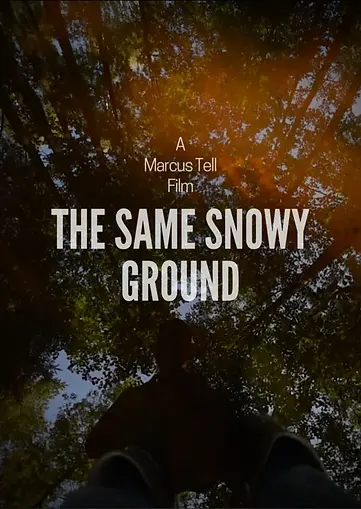
The Same Snowy Ground
Documentary, Germany, 43 minutes, 2020
Synopsis:
A journey through a place of an eternal past; where the grandson of a Jewish partisan sets out to experience the dramatic events and places that shaped his grandfather's war years.


Status:
Available online for free. For Screening, please contact the filmmaker.
Crew:
Filmmaker: Matan Tal
FAQ — The Same Snowy Ground
A film by Matan Tal
1) What is this film about — in one sentence?
In my own words, The Same Snowy Ground is a film about ghosts — about places where time is frozen, about visiting what is no longer there, and about filming absence itself as a presence. 
2) What genre is this film (and how would you describe its form)?
I consider this film an essay film. You could also call it a travelogue film, but only in a very specific sense.
According to my own filmmaking practice, it’s an essay film because it’s me moving through space and time, visiting places, asking questions, observing, and reflecting — not just on where I am, but on what used to be there. These are places with an eternal past, and the film moves constantly between the present state of those places and their past state. 
3) Why did you make this film?
I made this film because I have a strong desire to visit places before it’s too late.
Many places in the world change irreparably, and I wanted to capture them — not only on film, but also in my own mind. When I made The Same Snowy Ground, I had no idea that the war in Ukraine would start just a few years later, making this journey extremely difficult, if not impossible, today.
Traveling through Ukraine and Belarus now is very different. Borders are scrutinized differently. Back then, I crossed borders by foot, by car, by plane, by train — every possible way. I still remember the look on the border officer’s face when I entered the EU from Minsk via Latvia. She checked my passport again and again, trying to make sense of all those stamps.
That tension — of movement, of time closing in — is part of why this film exists at all. 
4) What is the central idea or question the film explores?
The central idea of The Same Snowy Ground is exploring places with an eternal past.
As I see it, the film is an attempt to film the unfilmable — to film ghosts. Not ghosts as figures, but ghosts as traces, as absences, as spaces where something decisive once happened and is now gone. 
5) What should the viewer pay attention to while watching?
Because this is a film about absence, I believe the viewer should pay attention to that feeling of absence while watching.
In my view, the only way to film ghosts is not to show them directly, but to show the absence of embodiment — to let the missing presence be felt rather than illustrated. 
6) What is your approach to editing in this film?
My approach to editing here was fairly standardized, and intentionally so.
According to my judgment, the editing follows a travelogue or documentary logic: moving from one place to the next, one location to another, one movement to another. The camera is always on the move, often shaky, always transitional. The editing reflects that continuous movement through space. 
7) How did you approach sound and voice (music / voiceover / silence) in this film?
Voiceover is one of the main tools of this film.
The narration follows my line of thought while I was there, and later, while watching the material again and trying to make sense of it. In my filmmaking practice, narration is not explanation — it’s thinking out loud, after the fact.
The soundtrack is equally important. The music adds a human presence and a sense of character to what could otherwise feel like a distant or purely observational film. 
8) How much of the film is scripted vs discovered during the process?
This film was not scripted at all.
I made The Same Snowy Ground with a quote by Chris Marker in mind. In an interview, he said that when he makes films, he has no idea what he’s doing — he simply goes with the camera and discovers.
That was my approach. I had travel arrangements and a camera, and I filmed what I saw, foolishly or not. The “script” only came later, when I wrote the narration. That’s when the structure emerged, retrospectively. 
9) What makes this film “experimental” (if it is) — and why did you choose that?
In my view, this is actually my least experimental film.
It’s not mainstream, because it’s an essay film, but formally speaking, I consider it quite standard within that tradition. To my best judgment, there is nothing in this film that I would confidently label as experimental. 
10) What films, artists, or influences shaped this work (directly or indirectly)?
The main influence I can clearly name is Claude Lanzmann’s Shoah.
What I took from his approach was not form or scale, but the decision to go to places where atrocities occurred and film them as they are today. The Same Snowy Ground was born from that same impulse: filming locations in their present state and using narration and music to carry memory, thought, and presence through them. 
11) Who is this film for — and what kind of viewer will connect with it most?
This film is for people who are interested in the ghosts it explores.
It’s for viewers who care about what was lost during World War II — the people, the places, the cultures — and who are interested in seeing what remains after that loss. It’s for those who want to look at absence rather than reconstruction. 
12) Where can I watch the film, and how can I contact you for screenings or programming?
The Same Snowy Ground is available online, on my website and elsewhere.
If you’re interested in screening the film or programming it, you can contact me directly. I’d be happy to arrange a screening and talk about the film.